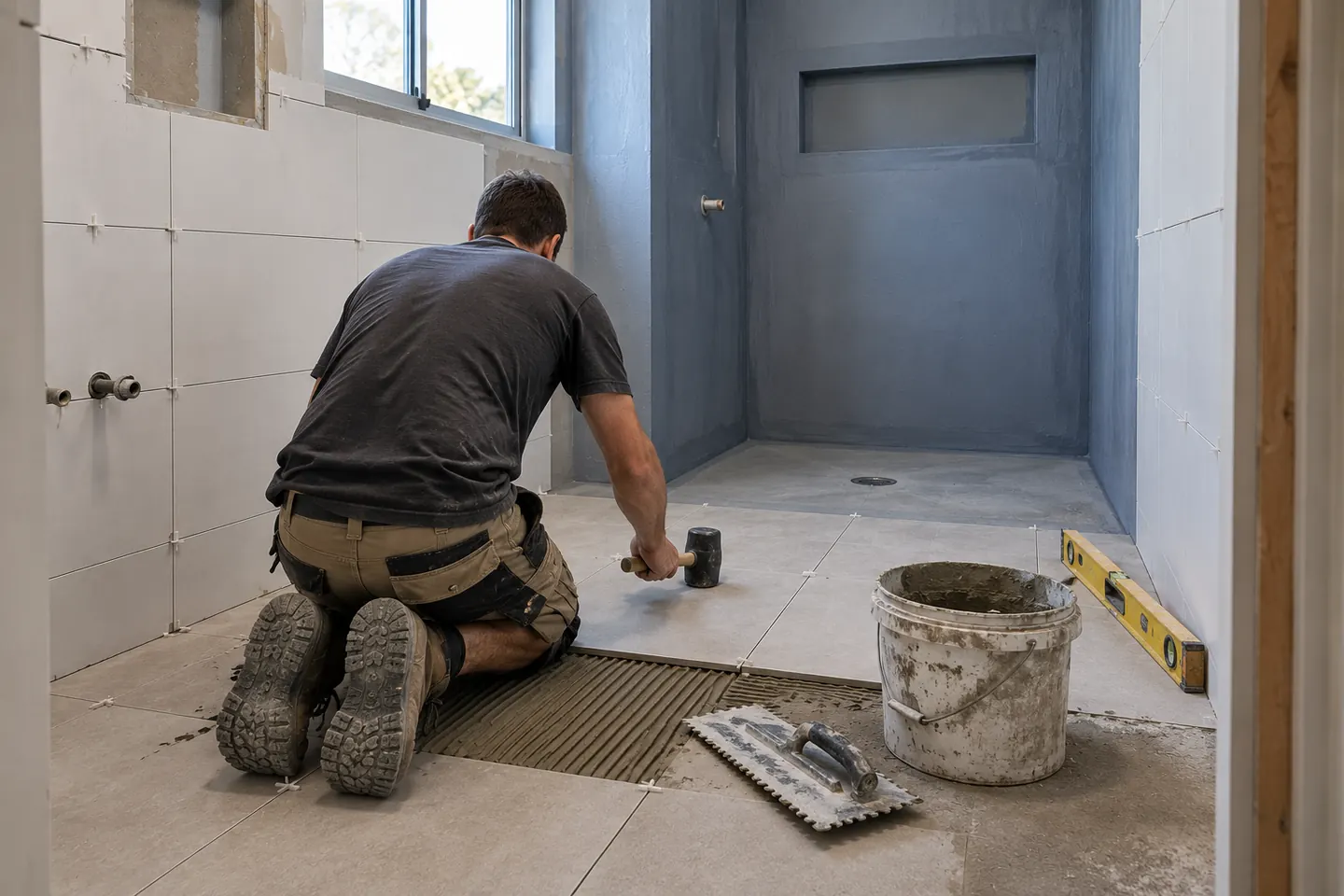
Why so many Wollongong showers leak
Old bathrooms were built without membranes. In many cottages and post-war houses, the only thing keeping water out of the floor was the tiles and the grout.
Early membranes and shower bases fail. In seventies and eighties brick veneer, acrylic shower bases crack and the seals around them break down.
Timber floors move. Older homes on piers and joists flex a little with the seasons, and rigid junctions crack.
Humidity never lets up. Near the escarpment, the room barely dries between showers, which is hard on grout and silicone.
Waterproofing, step by step
1. Back to a solid base
Old tiles, mortar bed and linings come out. On timber floors, new structural sheeting goes down, fixed properly so it doesn't move. Walls get wet-area board.
2. Waste and puddle flange
The floor waste is set at the right height with a flange that lets the membrane seal into it. A lot of leaks start right here.
3. Screed with a fall
The floor slopes to the waste so water runs away. In a step-free shower, the fall inside the shower is a bit steeper than across the rest of the room.
4. Corners and junctions
Bond breakers and flexible reinforcement where walls meet floors and where different materials meet, so small movements don't crack the membrane.
5. The membrane
Applied at the right thickness and number of coats: over the whole floor, up the shower walls, along the wall-floor junctions and at the doorway, with a water stop at the threshold.
6. Cure
Left to cure fully. In a damp Illawarra winter, that can take longer than the tin suggests. Don't rush it.
7. Photos and paperwork
Photos of the membrane before tiling, and any certificate from the waterproofer. Keep them with your house papers.
Australian Standard AS 3740 covers waterproofing of domestic wet areas, and waterproofing work in NSW should be done by a licensed contractor.
Timber floors vs slabs
Timber floors (cottages, older homes, upstairs bathrooms): need flexible junctions, structural sheeting and a membrane that suits movement. Worth checking the subfloor for rot and ventilation while it's open. Damp subfloors on sloping escarpment blocks are common.
Slabs (most brick veneer, units): more forgiving for waterproofing, but the waste position is basically fixed. In units, the waterproofing protects the neighbour below.
Tiling
Floor tiles
- Slip rating suitable for wet bare feet, especially in the shower
- Matt or textured finish over polished
- Larger formats for fewer grout lines, where the fall allows
- Smaller tiles or a linear drain in showers so the fall works cleanly
Wall tiles
- Full height, at least in the shower, so there's no paint near the steam
- Light colours in rooms with little natural light
- Satin or gloss finish for easy wiping
Grout and silicone
- Epoxy or high-performance grout on the shower floor
- Narrow joints with rectified tiles where walls are flat enough
- Mid-tone grout that hides marks
- Flexible sealant in corners and at the floor-wall junction, not grout
Set-out
Before a tile goes on, the tiler works out where the cuts will land. Good set-out keeps full tiles at eye level, lines up grout with the vanity and niche, and hides cuts in the corners you don't look at. Old cottage walls are rarely straight, so preparation matters.
What drives the tiling cost
- Area and height tiled
- Tile format — big tiles need flatter walls and more handling
- Pattern — herringbone, mosaics and diagonals take longer
- Mitred corners instead of trims
- Niches
- Floor prep in older, uneven rooms
A simple layout with one feature wall or a nice floor tile usually looks better and costs less than an expensive tile in a fussy pattern.
Common shortcuts to avoid
- Tiling over old tiles in a bathroom that's already leaking
- Tiling before the membrane is fully cured
- No fall in the shower, so water sits in the corner
- Grout instead of silicone in the corners, which cracks
- No photos of the membrane, so nobody can prove what's under there
The builder
Renovation work is carried out in partnership with Coastal Renovation Group, a licensed NSW builder, with waterproofing by appropriately licensed trades. Licence and insurance details are provided on request. See how a job runs for where these stages sit.
Call 02 4214 4073 or send the bathroom details through.
Questions people ask before they commit
How do I know if my shower's leaking?
Look for grout that stays dark long after a shower, loose or hollow-sounding floor tiles, swollen door frames or skirting outside the bathroom, peeling paint on the other side of the shower wall, and a musty smell under the house or in the next room.
Can I just regrout to stop a leak?
If the membrane underneath is sound and the problem is cracked grout or old silicone, regrouting and resealing can fix it. If the membrane has failed or was never there, regrouting only hides the problem for a while.
How long does waterproofing take to cure?
It depends on the product and the weather. Many membranes need a day or more between coats and longer before tiling. Wollongong's humid, rainy spells can slow curing, so a good program leaves room for it.
What tiles are best for a bathroom floor?
A matt or textured porcelain with a slip rating suited to wet bare feet. Larger tiles mean fewer grout lines, but a shower floor with a centre waste may need smaller tiles so the fall works.